Crispy Garlic Parmesan Potato Wedges Recipe
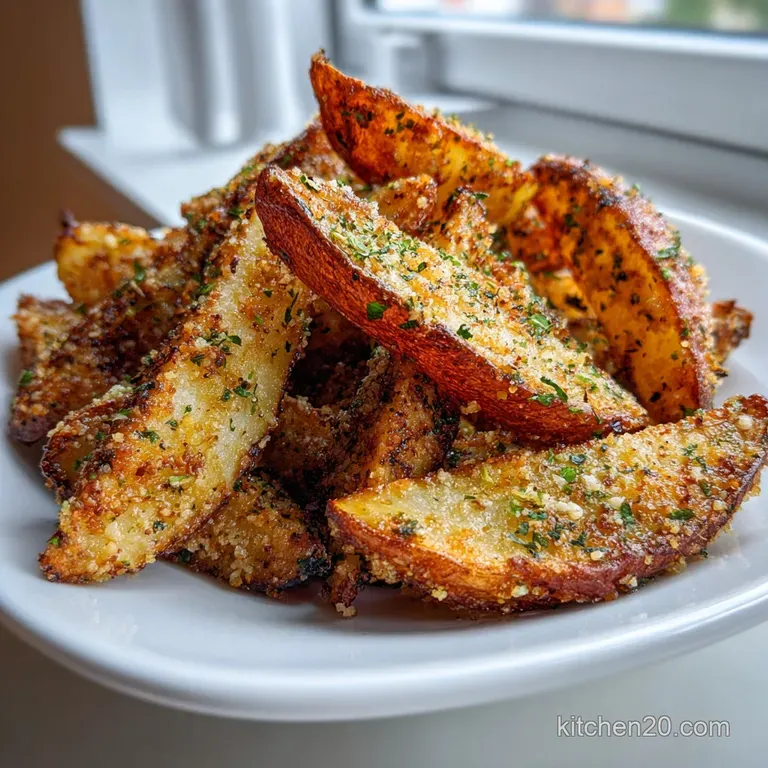
- Time: Active 15 minutes, Passive 35 minutes, Total 50 minutes
- Flavor/Texture Hook: Shatter crisp exterior with a velvety, cloud like center
- Perfect for: Game day gatherings, steakhouse style dinners, or an innovative snack platform
- Mastering This Crispy Garlic Parmesan Potato Wedges Recipe
- The Physics of Shatter Crisp Wedges
- Analyzing the Ingredient Infrastructure
- Elements for the Perfect Crunch
- Essential Tools for Success
- The Step-By-Step Roasting Platform
- Fixes for Common Potato Pitfalls
- Clever Swaps and Creative Tweaks
- Storing and Reheating for Freshness
- Pairing Ideas for Your Spread
- Crispy Garlic Parmesan Potato Wedges Recipe FAQs
- 📝 Recipe Card
Mastering This Crispy Garlic Parmesan Potato Wedges Recipe
The air in my kitchen usually carries a specific frequency when the oven hits 425°F, but nothing compares to the sizzle that erupts when cold soaked starch hits a preheated tray. I remember the exact moment I realized my old way of making wedges was fundamentally broken.
I was hosting a small launch party for a friend's new app, and the potatoes I’d spent an hour on were nothing more than limp, oil soaked sponges. It was a total system failure. I realized then that roasting potatoes isn't just about heat, it's about managing the moisture to starch ratio on a microscopic level.
We aren't just making a side dish here, we're building a platform for flavor. After that party disaster, I went into a deep dive on starch gelatinization. I started treating my kitchen like a lab, testing how different fats and coatings interacted with the potato skin.
What I discovered was a revolutionizing approach that involves cornstarch and a specific two stage parmesan application. This method ensures every bite has that audible crackle we crave.
This recipe is the result of those failed Friday nights and the connective power of a really good snack. When you pull these out of the oven, the aroma of toasted garlic and sharp cheese creates an immediate connection between everyone in the room. You'll see people reaching for the gnarly, extra crispy bits first.
That’s the sign of a successful build. Let's look at how we can replicate these results in your own kitchen every single time.
The Physics of Shatter Crisp Wedges
Starch Reinforcement: Adding cornstarch to the potato surface creates a secondary dehydrated layer that browns faster and more intensely than the potato's natural sugars. This thin "shell" acts as a barrier, preventing the interior moisture from migrating outward and softening the crust.
- Surface Dehydration: Soaking removes excess surface starch that usually gums up and causes sticking, while thorough drying ensures the oil fries the skin rather than steaming it.
- Emulsified Coating: The olive oil and dried seasonings form a high viscosity slurry that clings to the wedges, ensuring 360 degree coverage without pooling on the pan.
- Maillard Synchronization: By adding fresh garlic at the end, we prevent the bitter carbonization that occurs when minced garlic is exposed to high heat for too long.
- Protein Crystallization: The Parmesan cheese melts and then solidifies into "lace" structures, providing a salty, umami rich crunch that contrasts with the soft interior.
| Method | Time | Texture | Best For |
|---|---|---|---|
| Convection Oven | 35 minutes | Ultra even shatter crisp | Large batches and hosting |
| Standard Oven | 42 minutes | Deeply browned, rustic | Traditional home cooking |
| Stovetop Skillet | 25 minutes | Patchy crunch, soft sides | Quick solo meals |
The choice between a standard oven and a convection setting is all about airflow. In a convection setup, the moving air strips away the "steam envelope" surrounding each wedge much faster, leading to a more consistent crunch across the entire tray. If you are using a standard oven, you might find that the Garlic Herb Mashed recipe is a more forgiving alternative for high volume crowds, but for that specific wedge texture, the oven remains the gold standard platform.
Analyzing the Ingredient Infrastructure
| Ingredient | Science Role | Pro Secret |
|---|---|---|
| Russet Potatoes | High starch, low moisture | Look for "dusty" skins which indicate lower water content for better frying |
| Cornstarch | Amylose rich crisping agent | Dusting through a fine mesh sieve prevents clumping for a micro thin layer |
| Parmesan Cheese | Umami fat binder | Grate it yourself on a microplane to create "snow" that melts instantly |
| Smoked Paprika | Color and depth | This provides the "visual signal" of doneness before the crunch is even felt |
Elements for the Perfect Crunch
To execute this recipe properly, you'll need 4 large Russet potatoes (approx. 900g), which provide the solid structural foundation we need. We'll be using 2 tbsp cornstarch to reinforce the exterior and 3 tbsp extra virgin olive oil as our heat transfer medium.
The flavor profile is driven by 1/2 cup freshly grated Parmesan cheese and a robust spice blend: 1 tbsp garlic powder, 3 cloves fresh garlic (minced), 1 tsp smoked paprika, 1 tsp dried Italian seasoning, 1 tsp fine sea salt, and 1/2 tsp freshly cracked black pepper.
Finally, we finish with 1 tbsp fresh parsley for a hit of brightness.
- Russet Potatoes (4 large): These are non negotiable for the fluffiest interior.
- Substitute: Yukon Gold. Why this? They offer a creamier, waxier texture but won't be as "shattery" on the outside.
- Cornstarch (2 tbsp): This is our secret weapon for the "glass like" crust.
- Substitute: Arrowroot powder. Why this? Provides a similar crispness and is a great grain free alternative for sensitive diets.
- Extra Virgin Olive Oil (3 tbsp): Provides the fat needed for the Maillard reaction.
- Substitute: Avocado oil. Why this? Has a higher smoke point, making it safer for very high temperature roasting.
- Parmesan Cheese (1/2 cup): The source of salt and umami.
- Substitute: Pecorino Romano. Why this? Adds a sharper, funkier tang that pairs beautifully with the smoked paprika.
- Garlic Powder (1 tbsp): Ensures even garlic flavor in every single crevice.
- Substitute: Granulated onion. Why this? Offers a different savory profile if you are avoiding high intensity garlic notes.
- Fresh Garlic (3 cloves): Added at the end for an aromatic, punchy finish.
- Substitute: Garlic infused oil. Why this? Simplifies the process while still providing that essential aromatic punch.
- Smoked Paprika (1 tsp): Provides a subtle wood fired flavor.
- Substitute: Sweet paprika. Why this? Offers the same vibrant color without the intense smoky undertones.
- Dried Italian Seasoning (1 tsp): A complex herb baseline.
- Substitute: Dried oregano and thyme. Why this? Allows you to control the specific herbal notes more precisely.
- Fine Sea Salt (1 tsp): Enhances all other flavor components.
- Substitute: Kosher salt. Why this? Use 1.5 tsp if using Diamond Crystal to account for the larger grain size.
- Black Pepper (1/2 tsp): Adds a necessary bite of heat.
- Substitute: White pepper. Why this? Provides a more floral, earthy heat that blends into the potato color.
- Fresh Parsley (1 tbsp): A final aesthetic and flavor refresh.
- Substitute: Fresh chives. Why this? Adds a mild onion like brightness that complements the garlic perfectly.
Essential Tools for Success
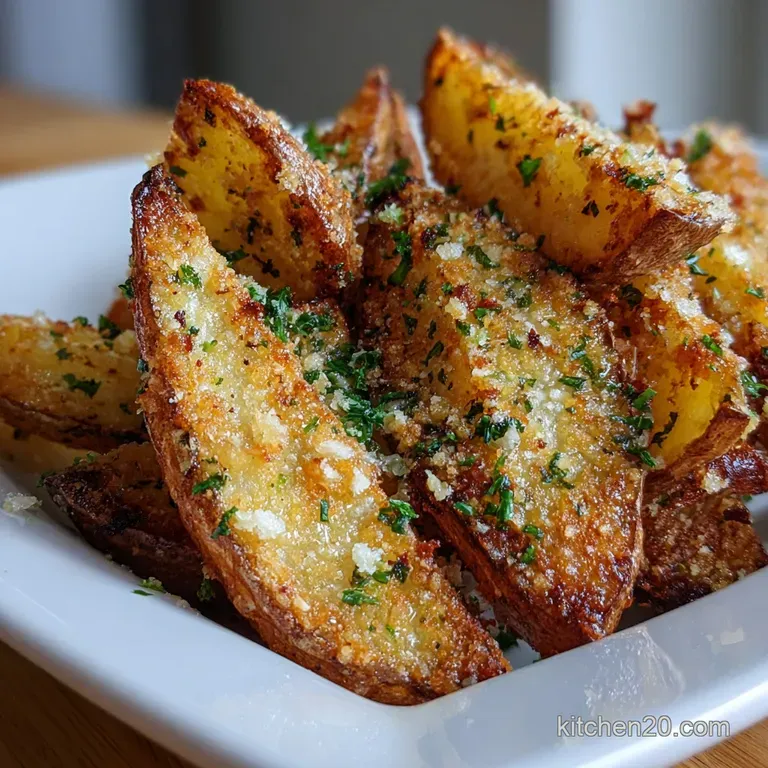
You don't need a high tech lab to get these results, but the right gear acts as a force multiplier. I always reach for a heavy rimmed baking sheet (like a Nordic Ware half sheet) because thin pans tend to warp at 425°F, leading to uneven oil distribution.
A large stainless steel mixing bowl is essential for the "aggressive toss" needed to build the starch coating.
I also recommend using parchment paper rather than foil. While foil can get the potatoes very hot, the cheese tends to bond with it, leading to a "cheese loss event" when you try to flip them. Parchment paper provides a clean release every time. Finally,, a sharp chef's knife is your best friend here.
We want uniform wedges to ensure the cook times are synchronized across the entire batch.
The step-by-step Roasting Platform
- Prep the potatoes. Scrub 4 large Russet potatoes thoroughly and slice them into uniform wedges by cutting them in half lengthwise, then into quarters, then eighths. Note: Uniformity is the key to synchronized cooking across the tray.
- Soak the wedges. Place the cut potatoes in a large bowl of cold water for at least 15 minutes. Wait until the water turns cloudy, indicating the excess surface starch has been released.
- Dry completely. Drain the water and pat the potatoes with a clean kitchen towel until they are bone dry. Note: Any lingering moisture will create steam, which is the enemy of a shatter crisp crust.
- Apply the starch. Toss the dry wedges in a clean bowl with 2 tbsp cornstarch. Shake the bowl until no white clumps remain and the potatoes look slightly "dusty."
- Infuse with oil. Drizzle 3 tbsp extra virgin olive oil over the potatoes and toss vigorously to create a thin, even coating.
- Season the base. Sprinkle in 1 tbsp garlic powder, 1 tsp smoked paprika, 1 tsp Italian seasoning, 1 tsp salt, and 1/2 tsp pepper. Mix until the potatoes are vibrantly orange and fully coated.
- Arrange for airflow. Place the wedges on a parchment lined baking sheet, skin side down, ensuring they do not touch. Note: Overcrowding the pan creates a localized steam zone that prevents browning.
- Execute the first roast. Bake at 425°F for 20 minutes. Listen for a steady sizzle coming from the oven.
- The Cheese Flip. Remove the tray, flip each wedge, and sprinkle with 1/2 cup freshly grated Parmesan and 3 cloves minced fresh garlic.
- The Final Crisp. Return to the oven for 10-15 minutes until the edges are deep golden and the cheese is lacy.
- Garnish and Serve. Toss with 1 tbsp fresh parsley immediately while the oil is still active on the surface.
Fixes for Common Potato Pitfalls
Why Your Wedges Are Soggy
This is usually a moisture management issue. If you don't dry the potatoes thoroughly after soaking, the water turns to steam inside the oven. That steam softens the starch layer before it has a chance to crisp up.
Plus,, if the oven temperature isn't high enough, the interior cooks before the exterior can dehydrate into a crust.
Why Your Garlic Is Bitter
Fresh garlic is delicate. If you add it at the very beginning of a 40 minute roast at 425°F, it will carbonize. Burnt garlic has a sharp, acrid taste that can ruin the entire batch.
This is why we use garlic powder for the long haul flavor and only add the fresh minced garlic during the final 10 minutes of roasting.
| Problem | Root Cause | Solution |
|---|---|---|
| Sticking to pan | High sugar or low oil | Use parchment paper and ensure even oil coating |
| Uneven browning | Crowded pan | Use two trays or cook in batches to allow air circulation |
| Flabby skin | Low oven temp | Calibrate oven with a thermometer; ensure it hits a true 425°F |
Common Mistakes Checklist
- ✓ Never skip the cold water soak; it's the only way to remove the surface starch that causes gumminess.
- ✓ Pat the potatoes dry like your life depends on it; moisture is the primary enemy of the crunch.
- ✓ Don't overcrowd the tray; if they are touching, they are steaming, not roasting.
- ✓ Use freshly grated Parmesan; pre shredded cheese contains cellulose which prevents a clean melt and crisp.
- ✓ Preheat your baking sheet for 5 minutes before adding the potatoes for an instant sear.
Clever Swaps and Creative Tweaks
When scaling this recipe down for a solo session, you can easily halve the ingredients, but keep the oven temperature the same. If you're cutting it down to 2 potatoes, use a smaller quarter sheet pan to prevent the oil from spreading too thin and burning.
For larger crowds, I recommend scaling up to 8 potatoes but using two separate racks in the oven. Just remember to swap the positions of the trays halfway through to ensure even heat distribution from the top and bottom elements.
If you find yourself out of certain spices, you can pivot the flavor profile entirely. For a Mediterranean vibe, swap the paprika for dried lemon peel and extra oregano. If you're feeling a bit more indulgent, serving these alongside a side of my Garlic Butter recipe for dipping is a total revolutionizing move for your dinner table.
| Occasion | Quantity Adjustment | Cooking Note |
|---|---|---|
| Date Night | 2 large potatoes | Use a toaster oven for efficiency |
| Family Dinner | 4 large potatoes | Standard 9x13 or half sheet pan |
| Game Day Party | 10 large potatoes | Requires 3 trays; rotate every 15 mins |
Chef's Tip: If you want an extra layer of "gnarly" texture, use a fork to scuff up the surface of the potatoes after boiling (if using a par boil method) or after the soak. Those little ridges become the ultimate conduits for crispy cheese.
Storing and Reheating for Freshness
The biggest myth in the potato world is that you can't reheat a wedge. While they will never be quite as "shattery" as they are 30 seconds out of the oven, you can get close. Avoid the microwave at all costs; it will turn your crispy masterpieces into rubber.
Instead, use an air fryer or a toaster oven set to 400°F for about 5 minutes. This rapidly re hydrates the surface oil and crisps the cheese back up.
For storage, keep them in an airtight container in the fridge for up to 4 days. If you have leftovers that are past their prime, don't throw them away. Chop them up and fry them in a pan with some onions for the best breakfast hash you've ever had.
You can also freeze the raw, starched wedges on a tray before baking; this allows you to have "ready to roast" wedges whenever the craving hits. Just add 10 minutes to the total cook time if roasting from frozen.
Pairing Ideas for Your Spread
These wedges are a social catalyst. They pair beautifully with a heavy protein like a pan seared ribeye or a roasted chicken. Because of the garlic and parmesan profile, they also act as a great bridge for lighter fare.
Try serving them with a crisp Caesar salad; the warm potatoes and cold greens create a fantastic temperature contrast that keeps the palate engaged.
If you're building a full "potato centric" spread for a party, you could even pair these with a Roasted Fingerling Potatoes recipe to show off different textures. The fingerlings provide a creamy, buttery experience while these wedges bring the high octane crunch. Finish the spread with a few different dipping sauces a spicy aioli or a truffle mayo and you've successfully built an innovative appetizer platform that will be the talk of the evening.
Honestly, don't even bother with low-fat cheese or skipping the oil. These wedges are meant to be an indulgence, a connective piece of comfort food that reminds us why we love to cook in the first place.
When you hear that first "crunch" from across the table, you'll know exactly why we put in the extra effort to get the science right. Enjoy the process, and let the sizzle guide you.
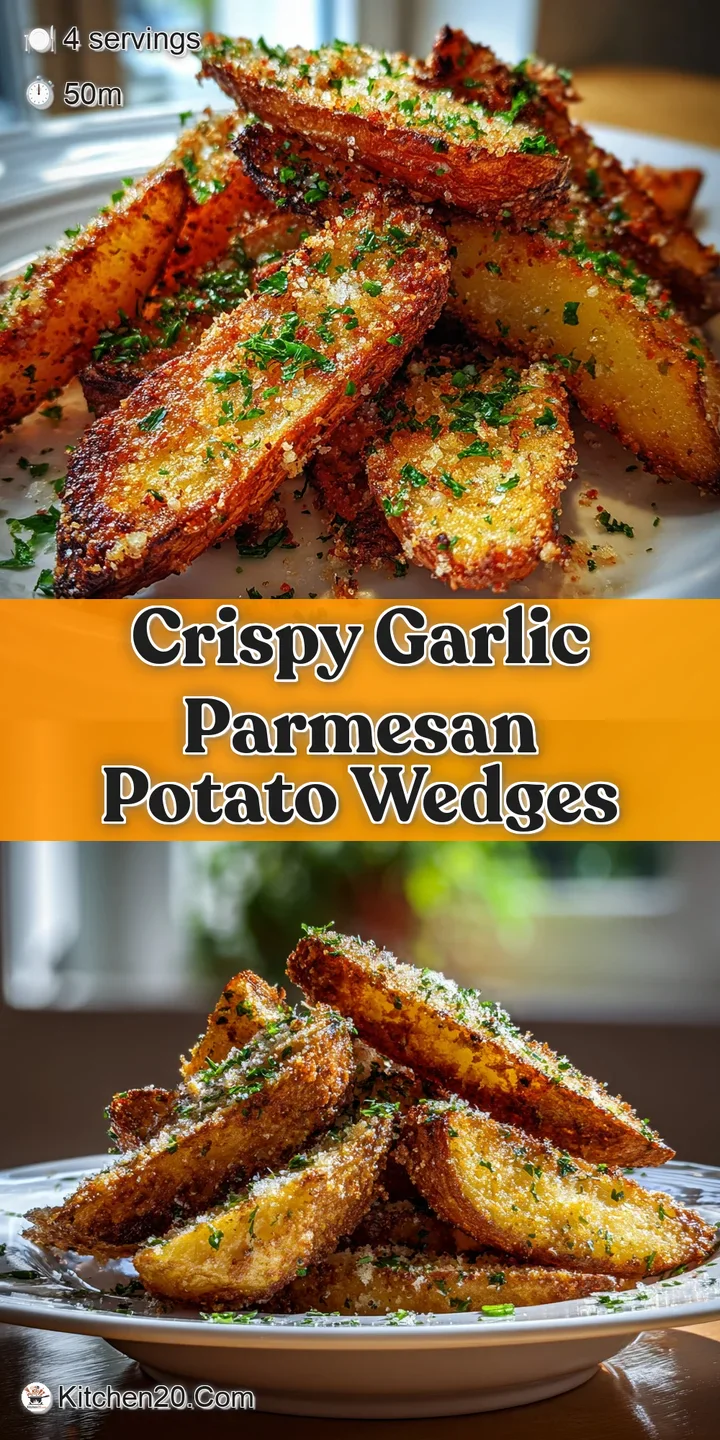
Crispy Garlic Parmesan Potato Wedges Recipe FAQs
What is the ideal oven temperature for achieving maximum crispness?
Bake at 425°F (220°C). This high heat ensures rapid surface dehydration before the interior steams, which is critical for the shatter crisp crust we are targeting.
How do I prevent the wedges from sticking to the baking sheet?
Use parchment paper and preheat the sheet. While parchment is effective, briefly preheating the sheet for five minutes before adding the coated wedges ensures an immediate sear upon contact.
Why must I soak the cut potatoes in cold water before seasoning?
To remove excess surface starch. Soaking releases the starch that would otherwise turn gummy or gluey when cooked, resulting in a softer texture rather than a crisp shell.
How can I make these wedges crispy if I prefer not to use cornstarch?
Use a double roast technique with high heat. Roast the oiled wedges naked at 400°F until well browned, then add the Parmesan and roast for a final 10 minutes; this is similar to the heat control needed for our How to Make recipe
When is the best time to add the fresh minced garlic?
Add the fresh garlic during the last 10 to 15 minutes of baking. Adding it too early at high heat will cause it to burn, resulting in a bitter, acrid flavor profile.
Is it necessary to grate the Parmesan cheese fresh for this recipe?
Yes, grating the cheese fresh is highly recommended. Pre-shredded varieties contain anti caking agents like cellulose, which prevents them from melting down properly into the desired lacy, crisp coating.
What is the best way to reheat leftover wedges to retain crunch?
Use an air fryer or toaster oven at 400°F for 5 minutes. The microwave softens the texture by reintroducing steam; a dry convection heat source is required to rapidly crisp the exterior again.
Crispy Potato Wedges Recipe
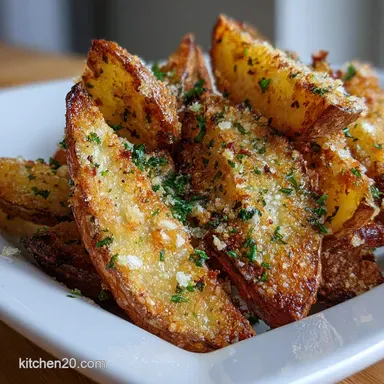
Ingredients:
Instructions:
Nutrition Facts:
| Calories | 336 kcal |
|---|---|
| Protein | 8.9 g |
| Fat | 13.4 g |
| Carbs | 42.6 g |
| Fiber | 5.0 g |
| Sugar | 1.4 g |
| Sodium | 775 mg |
