Cinnamon Roll Casserole | Maple-Caramelized Brunch Perfection
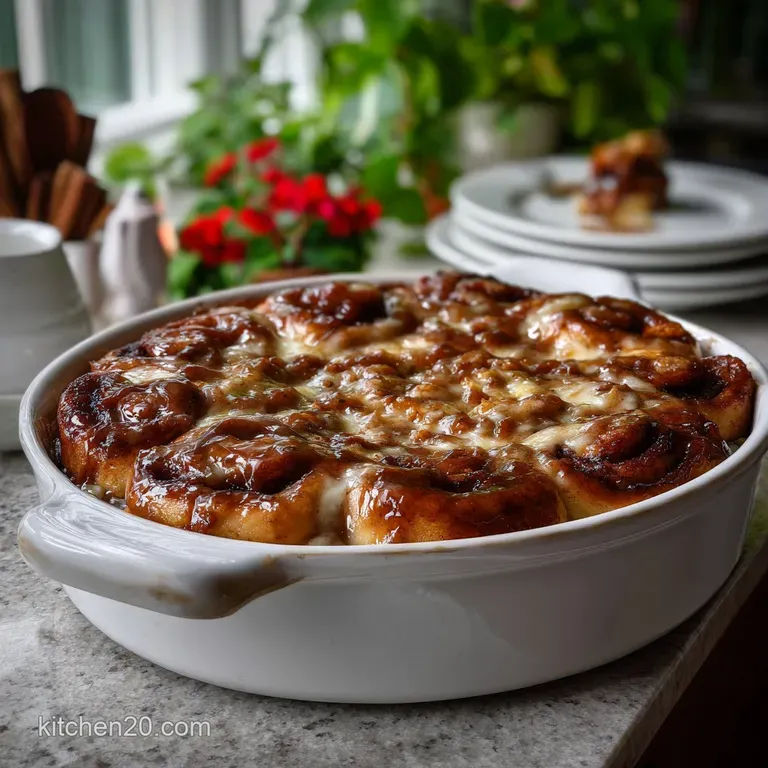
- Effort/Time: Minimal prep (15 minutes), high-impact result.
- Flavor Hook: Syrupy maple-caramelized edges with a velvety, bread-pudding-style interior.
- Perfect for: Crowd-pleasing holiday breakfasts and make-ahead weekend brunches.
- The Molecular Fusion of Dough and Custard
- Precision Timing and Quantitative Yield Metrics
- The Chemistry of Flavor: Sourcing Your Elements
- Thermal Conductivity: Selecting Your Culinary Instruments
- The Sequential Protocol for Structural Integrity
- Navigating Texture Failures and Structural Collapse
- ⚗️ The Scaling Lab: The Physics of Quantity
- Common Myths of the Breakfast Bake
- Engineering Flavor Shifts through Strategic Modification
- Preservation Tactics and Thermal Recovery Procedures
- Aesthetic Presentation and Flavor Pairing Strategies
- Recipe FAQs
- 📝 Recipe Card
The Molecular Fusion of Dough and Custard
There is nothing worse than biting into a breakfast bake only to find a texture that alternates between dry bread and a literal pool of raw, slimy egg. I once served a version of this cinnamon roll casserole to my in-laws where the center was basically a cold, cinnamon flavored soup because I ignored the physics of heat penetration.
The financial cost of wasted ingredients is one thing, but the emotional cost of a "failed" holiday morning is much heavier.
I destroyed at least five test batches by over saturating the dough before I realized that custard absorption is a function of surface area and starch gelatinization. The secret isn't just dumping ingredients into a pan; it's about creating enough "crater" space for the liquid to nestle without drowning the gluten structure.
When you get it right, the result is a cinnamon roll casserole that offers a shattering, sugary crust over a pillowy, tender crumb.
The scientific revelation here is the use of heavy cream to stabilize the egg proteins. By increasing the fat content, we prevent the "scrambled egg" texture that occurs when proteins denature too quickly under high heat.
This creates a velvety mouthfeel that mimics a high end French toast bake while keeping the convenience of a cinnamon roll casserole recipe.
Precision Timing and Quantitative Yield Metrics
Achieving the ideal texture for this cinnamon roll casserole requires strict adherence to thermal timelines to ensure the center reaches the safe and structural temperature of 160°F (71°C).
- Prep Time:15 minutes
- Cook Time:35 minutes
- Total Time:50 minutes
- Recipe Yield: 10 servings
The Chemistry of Flavor: Sourcing Your Elements
Selecting the right components for your cinnamon roll casserole dictates whether the final result is a structural success or a soggy collapse. We use high fat dairy and pure extracts to ensure the aromatic profile withstands the intense heat of the oven.
| Ingredient | Chemical/Physical Role (Science) | The Pro Secret (Why This Matters) |
|---|---|---|
| Heavy Cream | High fat-to-water ratio stabilizes protein bonds. | Prevents the custard from weeping or turning watery during the bake. |
| Large Eggs | Act as a protein binder and emulsifier. | Provides the structural "lift" that keeps the casserole from deflating. |
| Maple Syrup | Hygroscopic sugar that retains moisture. | Creates a tacky, caramelized glaze that stays soft even after cooling. |
| Pure Vanilla Extract | Alcohol based aromatic carrier. | Volatilizes in the oven, infusing the dough layers with deep floral notes. |
Essential Components
- 2 cans (12.4 oz each) Pillsbury refrigerated cinnamon roll dough: Why this? Specific leavening agents ensure consistent rise in a crowded pan.
- 4 large Happy Egg Co. eggs: Why this? High yolk-to-white ratio provides a richer, more golden custard.
- 1/2 cup heavy cream: Why this? 36% fat content prevents the custard from curdling at 350°F.
- 1/4 cup Grade A Dark maple syrup: Why this? Contains complex minerals that enhance the Maillard reaction.
- 2 tsp Nielsen Massey pure vanilla extract
- 1 tsp ground cinnamon
- 1/4 tsp Morton Kosher salt
- 2 tbsp Kerrygold unsalted butter, melted
- Reserved icing containers from dough
Thermal Conductivity: Selecting Your Culinary Instruments
To ensure even heat distribution and prevent the bottom of your easy cinnamon roll casserole from scorching before the center sets, the material of your pan is critical.
- 9x13-inch Pyrex Glass Baking Dish: Glass is an insulator; it heats up slowly but holds temperature steadily, which is vital for custards.
- Large KitchenAid Mixing Bowl: Used for whisking the custard to ensure full aeration of the eggs.
- Lodge 10 inch Cast Iron Skillet (Alternative): If you want ultra crispy edges, the thermal mass of cast iron is superior, though it may require a shorter bake time.
- Whisk or Fork: Necessary to break the protein strands in the egg whites for a smooth emulsion.
- Chef’s Knife or Kitchen Shears: Used to segment the dough into uniform pieces for even cooking.
The Sequential Protocol for Structural Integrity
This cinnamon roll casserole relies on a specific assembly order to ensure every piece of dough is coated but not submerged.
- Preheat the oven to 350°F (175°C) until the internal thermometer stabilizes.
- Grease the 9x13-inch Pyrex dish with 1 tablespoon of melted Kerrygold butter until the surface glimmers.
- Segment each cinnamon roll into 6 equal pieces using kitchen shears until you have uniform dough nuggets.
- Distribute the dough pieces evenly in the prepared dish until the bottom is completely covered but not packed.
- Whisk the eggs, heavy cream, maple syrup, vanilla, cinnamon, and salt until the mixture is pale and no streaks of egg white remain.
- Pour the custard mixture over the dough pieces until every crevice is filled.
- Drizzle the remaining 1 tablespoon of melted butter over the top until a light fat layer coats the surface.
- Bake for 35 minutes until the center no longer jiggles and the tops are mahogany brown.
- Warm the reserved icing in the microwave for 10 seconds until it reaches a pourable, syrupy consistency.
- Glaze the hot roll casserole immediately until the icing melts into the warm dough layers.
Navigating Texture Failures and Structural Collapse
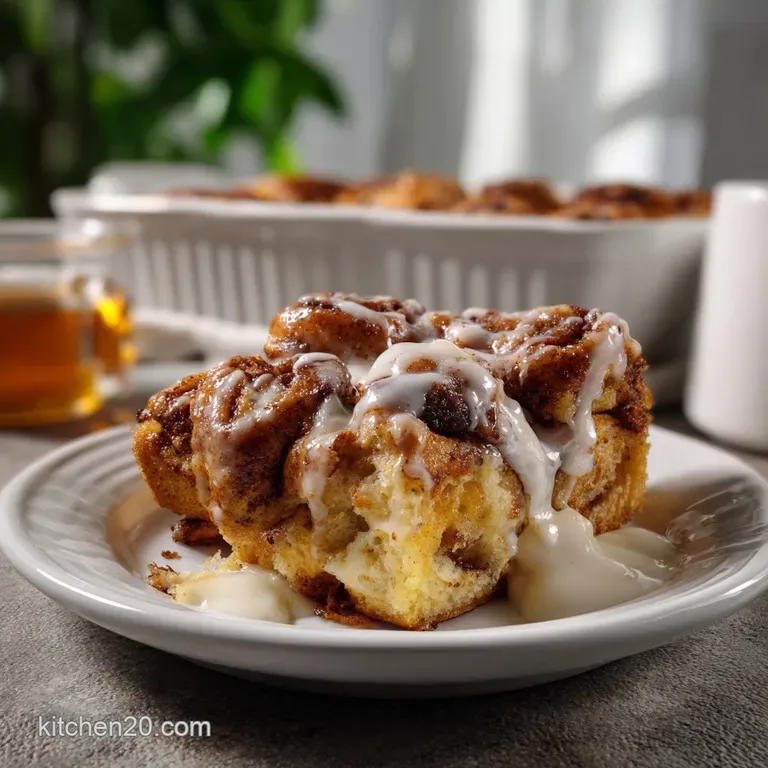
Why Your Casserole is Soggy
If the center of your cinnamon roll casserole is mushy, the starch gelatinization was likely interrupted. This happens if the oven temperature is too low or if the custard-to-dough ratio is skewed by using smaller dough cans.
Starch needs to reach approximately 165°F to fully absorb the surrounding liquid and set.
| Problem | Root Cause | The Fix | Pro Protocol |
|---|---|---|---|
| Soggy Bottom | Excessive moisture pooling at the base. | Use a glass dish for slower, more even heat penetration. | Pre-bake the dough for 5 minutes before adding custard. |
| Burnt Edges | Sugar caramelizing too fast (Maillard overdrive). | Tent the dish with aluminum foil halfway through. | Move the rack to the middle position to avoid floor heat. |
| Rubbery Texture | Over whisking eggs (protein entanglement). | Whisk eggs just until combined, not frothy. | Use room temperature eggs for easier emulsification. |
⚗️ The Scaling Lab: The Physics of Quantity
When doubling this cinnamon roll casserole recipe, you must account for the Square Cube Law. Doubling the ingredients in a single larger pan significantly increases the distance heat must travel to reach the geometric center.
- Thermal Mass: A double batch has a much higher thermal mass. If you use two separate 9x13 pans, the cooking time remains roughly the same. If you use one deep, large pan, you must reduce the temperature by 25°F and extend the bake time by 15 20 minutes to avoid burning the exterior while the center remains raw.
- Evaporation Paradox: In a larger pan, you have less surface area relative to the volume. This means less steam escapes. To compensate, reduce the heavy cream by 10% in a doubled batch to ensure the center sets firmly.
- Flavor Saturation: Do not double the salt or cinnamon. Scale them by 1.5x instead. Spices accumulate non-linearly in dense bakes, and doubling them can lead to an overpowering, astringent aftertaste.
Common Myths of the Breakfast Bake
Myth: You must soak the dough overnight for the best flavor. Truth: Unlike a dense French bread, refrigerated dough is highly porous. Soaking this recipe overnight will cause the chemical leaveners to fail, resulting in a flat, dense "pancake" texture.
A 15 minute soak is the scientific limit.
Myth: Lower fat milk works just as well as heavy cream. Truth: Milk has a higher water content. During baking, this water turns to steam, creating large air pockets and a "weeping" custard.
Heavy cream’s fat content coats the starch granules, creating a creamy, velvety interior that milk cannot replicate.
Engineering Flavor Shifts through Strategic Modification
This cinnamon roll casserole with heavy cream is a versatile base that can be modified to suit different seasonal profiles.
- Cinnamon Roll Casserole with Apples: Fold 1 cup of finely diced Granny Smith apples (tossed in lemon juice) into the dough pieces. The malic acid in the apples cuts through the sugar. This version pairs beautifully with my Baked Apples Recipe.
- Cinnamon Roll Casserole Crock Pot Method: Layer the ingredients in a greased slow cooker. Cook on LOW for 3 hours. Note: You will lose the "shattering" top crust, but gain a very moist, steamed pudding texture.
- dairy-free Swap: Replace heavy cream with full fat coconut milk (canned). Note: This adds a distinct tropical note and results in a slightly oilier finish due to the different fat structure of coconut.
- Autumn Variation: If you enjoy seasonal spices, serving this alongside a Classic Pumpkin Roll recipe creates a high contrast dessert spread for large gatherings.
Preservation Tactics and Thermal Recovery Procedures
Storage
Store leftovers in an airtight container in the refrigerator for up to 4 days. The sugar and fat act as natural preservatives, though the "crunch" of the top will soften over time due to moisture migration from the custard.
Freezing
You can freeze the baked cinnamon roll casserole for up to 2 months. Wrap individual portions in plastic wrap and then foil to prevent freezer burn.
Chef’s Note: Do not freeze the unbaked casserole; the yeast and leavening agents in the refrigerated dough will degrade, and the custard will separate upon thawing.
Reheating
To restore the "shatter" of the crust, reheat in an oven or air fryer at 325°F for 8 10 minutes. Microwaving for 45 seconds works for speed but will result in a soft, steamed texture.
💡 Zero Waste Philosophy
- Leftover Icing?Transform: Whisk with a tablespoon of bourbon or coffee to create a glaze for pound cake. Science: The sugar stabilized by the fat in the icing creates a shelf stable syrup.
- Dough Scraps?Transform: If you have small bits of dough left, roll them in cinnamon sugar and air fry for 4 minutes for "cinnamon bites."
Aesthetic Presentation and Flavor Pairing Strategies
To balance the high sugar content of the cinnamon roll casserole, serve it with high acid or high protein accompaniments. A side of thick cut, salty bacon provides a necessary umami counterpoint to the maple syrup.
For a sophisticated brunch, garnish the top with fresh raspberries or blackberries. The tannins and acidity in the berries break through the richness of the heavy cream. This dish also works well as a decadent dessert following a savory main, much like the transition between a heavy dinner and How to Make recipe for dinner rolls.
Always serve the glaze on the side if you aren't eating the entire pan at once. This allows individuals to control the sweetness and prevents the leftover portions from becoming overly soggy during storage.
The final visual cue should be a glistening, golden brown surface that crackles when pressed with a fork, revealing the steaming, velvety interior of the ultimate cinnamon roll casserole.

Recipe FAQs
how to make cinnamon roll casserole?
Cut refrigerated rolls into six pieces and arrange in a greased 9x13 dish. Whisk eggs, cream, maple syrup, and vanilla, then pour evenly over the dough. Bake at 350°F for 35 minutes until set and golden brown. For best technique, review our guide on breakfast casserole: Velvety Texture, No Weeping.
how to make cinnamon bun casserole?
Use high fat dairy for structural integrity. Heavy cream prevents the custard from separating, ensuring the baked center sets into a cohesive texture rather than weeping. This stabilization principle is key to avoiding curdling in custards.
how to make cinnamon roll bake?
Use uniform dough cuts for even heat transfer. Irregular pieces create areas of high and low dough density, leading to inconsistent thermal absorption and uneven cooking. Mastering segmentation is crucial for uniform lift.
how to make cinnamon roll french toast casserole?
Bake at 350°F for approximately 35 minutes. This temperature allows the outside sugars to caramelize while providing sufficient time for the center custard to reach the safe 160°F setting temperature. Over baking leads to a rubbery texture.
how long to cook cinnamon roll casserole?
Myth: Covering the casserole prevents burning. Reality: Covering early traps steam, preventing the essential surface dehydration needed for a crispy top. Foil should only be added if the top browns too quickly before the center is set.
Can I use store-bought icing?
Yes, the packaged icing is standard. While homemade is superior, the packaged icing melts perfectly into the warm casserole, providing necessary sweetness and moisture.
If you preferred to make rolls from scratch, see the detailed instruction in How to Make the Best Cinnamon Rolls: Grandma Betty's Secret!.
Why is my center runny?
Insufficient thermal penetration caused the failure. Not enough time or a low oven temperature means the egg proteins never coagulated fully past the liquid phase. If you struggle with temperature control, you may prefer baking savory items like our Classic Comfort Tuna Casserole: A Family Favorite Recipe as an alternative.
- Ensure oven calibration
- Use room temperature eggs
- Check liquid to dough ratio
Easy Cinnamon Roll Casserole

Ingredients:
Instructions:
Nutrition Facts:
| Calories | 351 kcal |
|---|---|
| Protein | 5.8g |
| Fat | 15.6g |
| Carbs | 47.2g |
| Fiber | 0.9g |
| Sugar | 24.5g |
| Sodium | 685mg |
