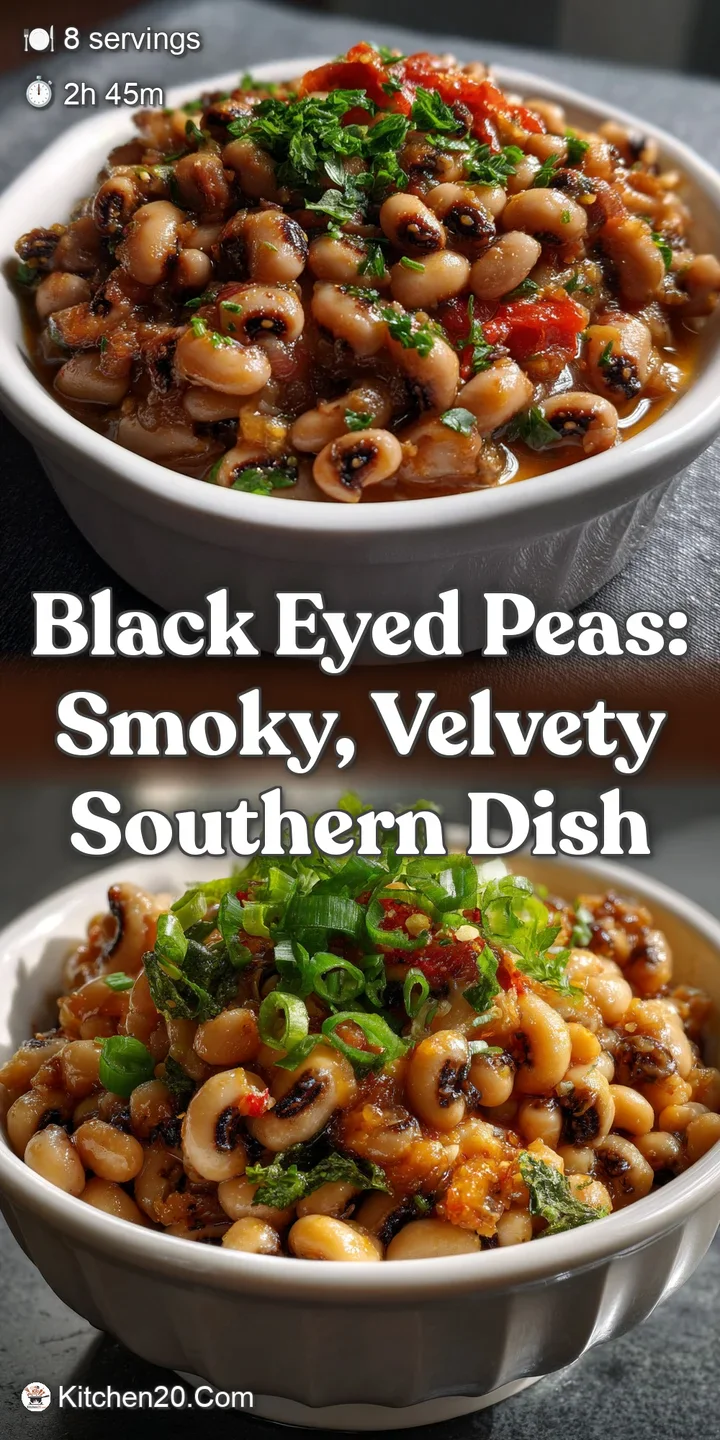
Black Eyed Peas: Velvety Southern Staple
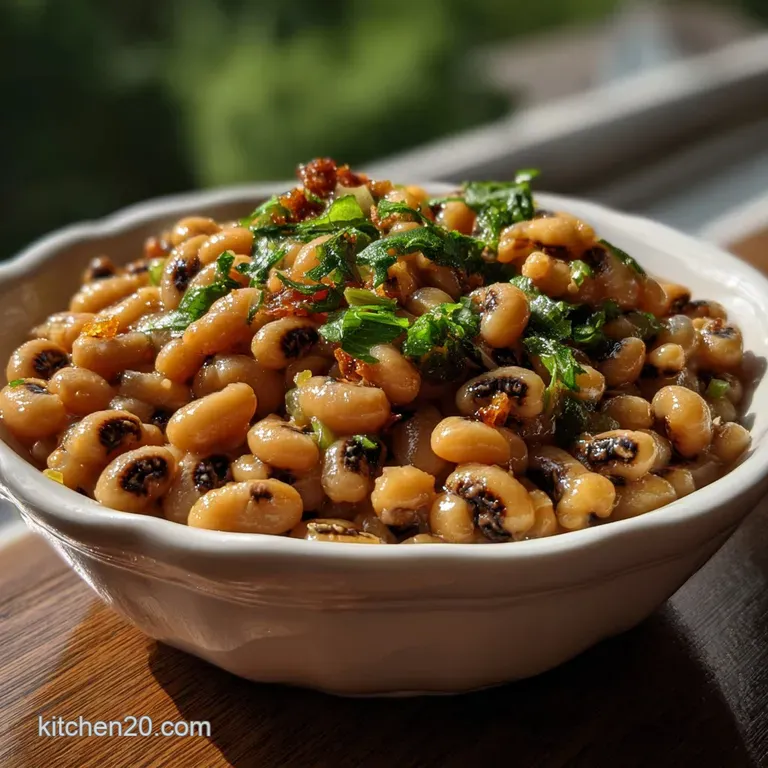
- Effort/Time: 2 hours 45 mins (low-active effort)
- Flavor Hook: Smoky, velvety, and umami-dense
- Perfect for: New Year's gatherings or high-protein meal-prep
- Engineering the Ultimate Southern Black Eyed Peas
- Precision Performance Metrics for This Recipe
- Selecting Your Culinary Material Arsenal
- Essential Hardware for High-Efficiency Braising
- Deconstructing the 10 Step Sequential Assembly Protocol
- Identifying and Mitigating Common Technical Failures
- Platform Modifications and Ingredient Exchange Modules
- ⚗️ The Math of Multiplication
- Realities vs. Kitchen Folklore
- Preservation Logistics and Life-Cycle Management
- Synergy Pairings and Social Network Integration
- Fast-Track vs Classic Benchmarking Analysis
- Common Questions
- 📝 Recipe Card
Engineering the Ultimate Southern Black Eyed Peas
New Year's Day in the South isn't just a date; it's a synchronized culinary event where the aroma of simmering legumes serves as a platform for community hope. Growing up, the rhythmic bubbling of the pot on the stove was the heartbeat of our home, promising prosperity and a shared connection to our ancestors.
This specific method focuses on revolutionizing the standard simmer into a high performance braise.
We aren't just boiling seeds; we are facilitating a complex network of flavor transfers between smoked collagen and fibrous plant proteins. The goal is a velvety consistency where the "pot liquor" becomes a rich, mahogany colored emulsion.
By approaching this dish as a series of thermal checkpoints, we ensure every bean retains its structural integrity while achieving a buttery interior.
This version moves beyond the basic boil to embrace a platform of layered aromatics. We use the "Holy Trinity" of Southern cooking onion, celery, and bell pepper to create a foundational motherboard of flavor.
When these elements connect with the deep, wood smoked essence of the ham hocks, the result is a dish that feels both nostalgically grounded and technically superior.
Precision Performance Metrics for This Recipe
To achieve mastery over these black eyed peas, we must look at the data driving the results. Consistency in temperature and hydration levels is what separates a grainy, shattered bean from a supple, cream filled one.
- Hydration Saturation: A 12 hour salt brine reduces cooking time by 25% and ensures even starch gelatinization.
- Thermal Extraction: Maintaining a steady 190°F (88°C) prevents the violent mechanical agitation that causes bean skins to rupture.
- Collagen Conversion: The smoked ham hocks require a minimum of 120 minutes to transition from tough connective tissue to a melt-in-the-mouth texture.
Why does a salted soak prevent "pebble" beans?
Soaking in 2 tbsp Sea Salt and 4 quarts Water facilitates an ion exchange where sodium ions replace magnesium and calcium in the bean's skin. This softens the cell walls, allowing moisture to penetrate the core more efficiently during the simmer.
Without this step, you risk "hard shell" syndrome, where the outside is mushy while the inside remains calcified.
How does the smoked pork transform the texture?
The 2 large Smoked Ham Hocks act as a natural emulsifier. As the collagen breaks down into gelatin, it weaves through the 6 cups Chicken Stock, creating a thick, lip-smacking viscosity. This isn't just flavor; it's a structural revolution that turns thin water into a velvety sauce.
Why wait to add acidic ingredients?
Adding 1 tbsp Apple Cider Vinegar too early is a technical error. Acid reinforces the pectin in the bean skins, essentially "locking" them in a firm state and preventing them from ever becoming tender.
We introduce the acid as a finishing module to brighten the heavy fats without compromising the bean's structural integrity.
| Feature | Classic Method (This Recipe) | Fast Track (Pressure Cooker) |
|---|---|---|
| Texture Profile | Velvety, integrated, complex | Firm, distinct, less emulsified |
| Liquid Quality | Rich "Pot Liquor" emulsion | Thin, broth like consistency |
| Aromatic Depth | Fully evolved via slow extraction | Surface level flavor saturation |
Selecting Your Culinary Material Arsenal
Success in the kitchen starts with high-quality components. We use Diamond Crystal Sea Salt for its clean salinity and low-sodium Chicken Stock to maintain total control over the final flavor profile.
| Ingredient | Chemical/Physical Role (Science) | The Pro Secret (Why This Matters) |
|---|---|---|
| Black Eyed Peas | Starch gelatinization platform | Sorting ensures no stones damage the "hardware" (your teeth) |
| Smoked Ham Hocks | Collagen hydrolysis & lipid release | Smoked depth provides a "maillard adjacent" woodsy base |
| Apple Cider Vinegar | pH adjustment & brightness | Cleanses the palate of heavy animal fats |
| Green Bell Pepper | Pyrazine aromatic compound | Adds a grassy "snap" that prevents the dish from tasting flat |
For the Brine
- 1 lb Dried Black Eyed Peas:Why this? Dried legumes offer superior starch control compared to canned versions.
- 2 tbsp Sea Salt: Essential for the ion-exchange process during the soak.
- 4 quarts Water: The medium for rehydration and cleaning.
The Smoky Base
- 2 large Smoked Ham Hocks:Why this? High collagen content provides the signature silky mouthfeel.
- 1 tbsp Extra Virgin Olive Oil: Used to conduct heat into the aromatics.
- 1 tsp Smoked Paprika: Reinforces the wood fired notes of the pork.
The Liquid and Aromatics
- 1 large Yellow Onion: Provides the sulfurous foundation of the flavor network.
- 3 cloves Garlic: Adds a pungent depth that mellows into sweetness.
- 2 stalks Celery & 1 Green Bell Pepper: The structural fiber that builds the aromatic base.
- 6 cups Chicken Stock (low sodium): The nutrient rich platform for the braise.
- 2 Dried Bay Leaves: Contributes a subtle, tea-like floral finish.
- 1/2 tsp Cayenne Pepper & 1 tsp Black Pepper: The heat module for sensory stimulation.
Essential Hardware for High Efficiency Braising
To execute this Black Eyed Peas Recipe with precision, you need equipment that manages heat distribution effectively. I prefer a Le Creuset 6.75 qt Round Dutch Oven for its superior thermal mass.
The heavy cast iron ensures that once we reach a simmer, the temperature remains rock solid, even if the stovetop fluctuates.
You will also need a Lodge 12 inch Cast Iron Skillet if you choose to sauté your aromatics separately for deeper caramelization, though a single pot method is more connective.
A Wüsthof 8 inch Chef’s Knife is mandatory for the finely diced yellow onion and celery, ensuring uniform surface area for even sweating. Finally, use a stainless steel spider skimmer to remove the ham hocks without disturbing the delicate beans.
Deconstructing the 10 Step Sequential Assembly Protocol
- Sort the 1 lb Dried Black Eyed Peas. Note: Removes debris and damaged beans that compromise texture.
- Dissolve 2 tbsp Sea Salt into 4 quarts Water. Note: Initiates the ion-exchange for skin softening.
- Submerge beans for 12 hours until they have doubled in size and look plump.
- Drain and rinse the beans thoroughly in cold water until the water runs clear.
- Heat 1 tbsp Extra Virgin Olive Oil in a Dutch oven until it shimmers and a faint wisp of smoke appears.
- Sauté the diced onion, celery, and bell pepper for 8 minutes until the onions turn translucent and smell sweet.
- Incorporate 3 cloves minced garlic and 1 tsp Smoked Paprika for 1 minute until the kitchen fills with a nutty, toasted aroma.
- Pour in 6 cups Chicken Stock and add the 2 large Smoked Ham Hocks until the liquid reaches a rolling boil.
- Simmer the beans and hocks on low for 2 hours until the beans are tender creamy and the hocks fall apart when touched.
- Stir in 1 tbsp Apple Cider Vinegar and 1/2 tsp Cayenne until the broth brightens and develops a shimmering mahogany sheen.
Chef's Note: For a "Masterpiece" finish, take one cup of the cooked beans and mash them against the side of the pot. Stir them back in to immediately increase the viscosity of the liquor.
Identifying and Mitigating Common Technical Failures

Even a seasoned pro can hit a glitch in the Cooking Black Eyed Peas process. Most issues stem from water chemistry or temperature spikes.
Why Your Beans Stay Hard
If your beans are still firm after 3 hours, your water likely has a high mineral content (hard water). Minerals like calcium bind to the bean's cell walls, making them nearly impenetrable.
| Problem | Root Cause | The Fix | Pro Protocol |
|---|---|---|---|
| Crunchy beans | Hard water minerals | Add 1/4 tsp baking soda | Distilled water is a fail safe for soak |
| Blown out skins | over High heat boil | Reduce to a bare simmer | Keep temp under 200°F (93°C) |
| Bland broth | Insufficient salt | Add salt in 1/2 tsp increments | Season the soak, not just the pot |
Why Your Broth is Thin
A watery liquor usually means the starches haven't been properly released or the collagen hasn't fully hydrolyzed. Similar to the logic in our Our Favorite Black recipe, a quick emulsification trick can save the day. Remove the lid for the final 30 minutes of cooking to allow for evaporation and concentration.
Platform Modifications and Ingredient Exchange Modules
We believe in a "connected" kitchen where recipes adapt to the user's local pantry.
| Original Ingredient | Substitute | Why It Works |
|---|---|---|
| Smoked Ham Hocks | Smoked Turkey Wings | Lower fat, but maintains the essential smoke profile. |
| Chicken Stock | Vegetable Broth + Soy Sauce | The soy provides the missing umami from the meat. |
| Dried Black Eyed Peas | Fresh Black Eyed Peas | Reduces cook time to 30 mins; no soaking required. |
- If you want a smokier profile: Double the Smoked Paprika and add a drop of liquid smoke.
- If you want a vegetarian version: Use 2 tsp smoked salt and add sun-dried tomatoes for glutamates.
- If you want more heat: Increase Cayenne to 1 tsp or add diced jalapeños with the bell peppers.
⚗️ The Math of Multiplication
When you need to scale this Southern Black Eyed Peas recipe for a community gathering, the physics of the pot changes.
- The Evaporation Paradox: If you double the recipe to 2 lbs of peas, do not double the chicken stock to 12 cups. In a standard wide Dutch oven, the surface area remains the same. Use 10 cups of stock instead to avoid a watery result.
- Flavor Saturation: Spices like cayenne and black pepper should be scaled by 1.5x (not 2x). Their sensory impact increases exponentially in larger volumes.
- The Square Cube Law: A larger volume of beans in the same pot traps more internal heat. Pull the pot off the heat 10 minutes early; the thermal mass will finish the cooking during the "carry over" resting phase.
Realities vs. Kitchen Folklore
Myth: Adding salt to the soaking water makes the beans tough. Truth: This is the opposite of the truth. Salted water actually breaks down the pectin in the skin, leading to a much creamier interior.
Myth: You must discard the soaking water to prevent "gas." Truth: While rinsing removes some complex sugars (oligosaccharides), most of the flatulence causing compounds are broken down by the long, slow simmer itself.
Preservation Logistics and Life Cycle Management
This dish is a "social network" favorite because it actually improves with time as the flavors continue to connect in the fridge.
Fridge: These beans will stay fresh for 4 5 days in an airtight container. The pot liquor will solidify into a jelly like state due to the gelatin; this is a sign of high-quality extraction. Freeze: Black eyed peas freeze beautifully for up to 6 months.
Freeze in individual portions to avoid repeated freeze thaw cycles which degrade the starch structure.
Zero Waste Philosophy
Don't discard those ham hock bones after shredding the meat. Transform: Simmer the stripped bones in 2 liters of water for 4 hours to create a secondary "remouillage" (re-wetting) stock. Science: There is still significant gelatin and smoke flavor deep within the bone marrow that can be used for future soups or as a base for our Black Eyed Peas Recipe.
Synergy Pairings and Social Network Integration
To complete the flavor circuit, you need a high contrast side dish. Traditionally, Southern Black Eyed Pea Dishes are paired with high acid or high crunch elements.
- Cornbread: The grainy texture and honey sweetness provide a structural foil to the creamy beans.
- Collard Greens: The bitter, iron rich leaves cut through the heavy lipids of the ham hock.
- Color Balance Strategy: To make this dish "pop" on the plate, utilize these three accents:
- Emerald: Freshly chopped flat leaf parsley added at the very end.
- Crimson: A final dusting of smoked paprika or a few rings of red chili.
- Amber: A thin drizzle of high-quality EVOO just before serving to add a shimmering light refraction.
Fast Track vs Classic Benchmarking Analysis
Sometimes you don't have 12 hours for a soak. Here is how to pivot while maintaining quality.
The Decision Shortcut
- If you have 3 hours: Follow the "Quick Soak" method boil beans for 2 minutes, let sit for 1 hour, then proceed.
- If you have 1 hour: Use a pressure cooker (Instant Pot) on high for 25 minutes with a natural release.
- If you have 15 minutes: Use canned beans, but simmer them in the rendered fat of some bacon to mimic the smoked hock depth.
This Fresh Black Eyed Peas Recipe approach ensures that no matter your timeline, you can deliver a connected, high flavor experience that honors the tradition while embracing modern kitchen physics.
Let's revolutionize your New Year's table with a dish that finally bridges the gap between folklore and science.
Common Questions
How to make black eyed peas?
Sort, soak beans for 12 hours in salted water, then simmer with smoked pork and aromatics until tender (about 2 hours). Achieving this velvety texture requires patience and proper soaking to facilitate starch gelatinization.
If you enjoyed mastering the slow simmer technique here, apply the same thermal control principles when learning about Quick Black Pepper Steak Tender Beef in 30 Minutes.
How to make black eyed peas in a crock pot?
Sauté aromatics first, then combine all ingredients and cook on low for 6 8 hours. The extended low-temperature exposure ensures the collagen in the ham hocks fully dissolves into the cooking liquid.
This long exposure maximizes connective tissue breakdown, creating a richer pot liquor than quick methods.
How to make black eyed peas taste good?
Finish with acid; use smoked meat for deep umami structure. Acid reinforces pectin structure if added early, but adding apple cider vinegar at the end brightens the heavy fats, preventing a flat flavor profile. The depth comes from fully rendering the collagen from smoked pork.
How to make black eyed peas in instant pot?
Pressure cook soaked beans on High for 25 minutes with a natural pressure release. While fast, high pressure can sometimes cause the skins to rupture mechanically, yielding a less cohesive texture than slow simmering. For a non-soup legume preparation, see how we manage structural integrity in Black Bean Burgers: Smoky Chipotle Recipe That Holds Shape.
How to make black eyed peas with smoked turkey?
Substitute smoked turkey wings or legs for ham hocks and increase smoked paprika slightly. Turkey provides a lighter fat content but maintains essential smoky compounds needed for the dish’s signature flavor.
The technique remains identical to the pork version, focusing on a long simmer time to soften the turkey skin.
Should I soak black eyed peas overnight?
Yes, soak 12 hours in salt water for optimal texture. Salt ions replace hard water minerals in the skin, allowing even moisture penetration for uniform tenderness. This prevents the common failure mode where the exterior is mushy and the interior remains hard.
Myth: Adding salt to the soaking water toughens the beans.
Myth: Adding salt to the soaking water makes the beans tough. Reality: Salt facilitates sodium ion exchange, softening the pectin matrix in the skin for better hydration. Rinsing beans after soaking is necessary to remove surface debris, not prevent hardening.
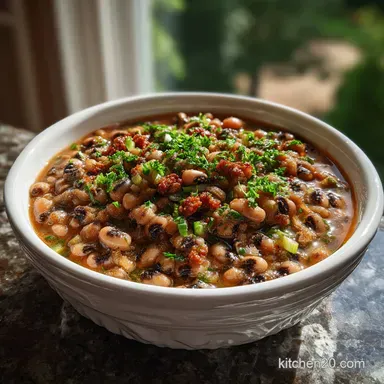
Revolutionary Black Eyed Peas
Ingredients:
Instructions:
Nutrition Facts:
| Calories | 294 kcal |
|---|---|
| Protein | 19.4 g |
| Fat | 7.2 g |
| Carbs | 36.5 g |
| Fiber | 6.2 g |
| Sugar | 3.1 g |
| Sodium | 845 mg |
