Dairy Free Sour Cream: Luxuriously Smooth Cashew
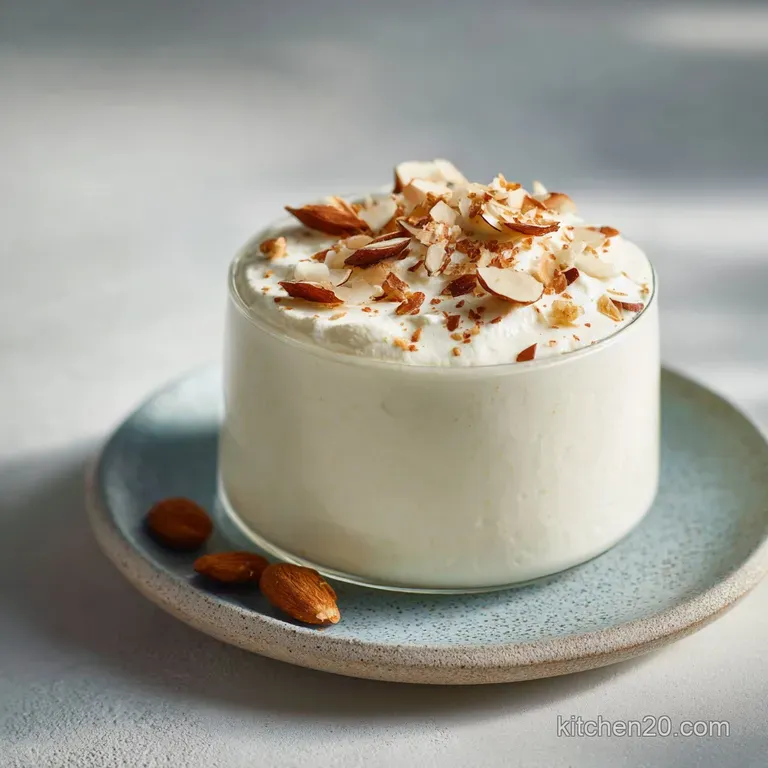
- The Crème de la Cashew: Achieving Authentic Sour Cream Tang Without the Dairy
- Decoding the Smoothness: The Science Behind Dairy-Free Cashew Cream
- Pantry Essentials: Ingredients for Your Cashew Sour Cream Base
- From Nut to Nondairy Delight: The Simple 3 Step Method
- Troubleshooting Your Cashew Sour Cream: Achieving Silky Smoothness
- Extending the Life of Your Dairy-Free Sour Cream
- Versatility Showcase: The Best Uses for Homemade Cashew Sour Cream
- Recipe FAQs
- 📝 Recipe Card
The Crème de la Cashew: Achieving Authentic Sour Cream Tang Without the Dairy
That dreamy, creamy, tangy mouthfeel is absolutely essential sometimes. If you’ve ever tried making truly excellent, homemade dairy-free Sour Cream , you know exactly what I’m talking about.
The texture should be thick enough to hold its shape on a hot baked potato, but still silky and bright on the tongue.
Forget the weird, gloppy store-bought stuff that tastes mostly like coconut or plastic. This specific dairy-free Sour Cream recipe is a total lifesaver because it’s ridiculously fast, cheap, and only uses ingredients you probably already have stashed in your pantry.
We bypass the stabilizers, the weird thickeners, and the high price tag entirely.
We are going straight to the gold standard: the raw cashew. They are the unsung heroes of plant based cooking. Let’s get blending and make the absolute best homemade dairy-free Sour Cream you will ever spoon onto tacos.
Decoding the Smoothness: The Science Behind dairy-free Cashew Cream
The biggest compliment I ever got on this recipe was, "Wait, this isn't just regular sour cream?" I swear this simple process creates the perfect dairy-free Sour Cream substitute. It’s not magic, but it is some excellent food science.
What Makes Cashew Cream So Superior?
Cashews are unique because they have a high fat content but a very neutral flavor profile. Unlike almonds or macadamia nuts, cashews blend into a completely seamless, uniform paste when properly hydrated. When we soak them, those fats and starches absorb water, breaking down their structure.
This preparation allows the high speed blender to perform the final essential step: emulsification. That's why this method for dairy-free Sour Cream works every single time.
Is This Recipe Truly Easier Than store-bought?
Absolutely, yes. You skip the trip to the obscure refrigerated aisle and instead spend five minutes prepping and three minutes blending. The rest is just chilling time, which is completely hands off.
Plus, you control the ingredients list, which means no mystery gums or thickeners sneak their way into your homemade dairy-free Sour Cream .
Quick Recipe Facts: Difficulty and Prep Time
This falls firmly into the "easy" category, assuming you own a decent blender. If you’re rushing, there's a quick soak method, but patience truly rewards you here with the creamiest consistency.
The Critical Role of Cashew Soaking
Please, please, please do not skip the soak. I know you want to. Trust me, I once threw unsoaked cashews into my blender thinking the motor could handle it and I ended up with a slightly gritty, warm mess instead of luxurious dairy-free Sour Cream .
Soaking the cashews softens the fibers, ensuring that the blender can truly pulverize them into an impossibly silky liquid.
Achieving the Perfect pH Balance (The Tang Factor)
Traditional sour cream gets its tang from lactic acid produced by bacterial cultures. We obviously aren’t culturing anything here, so we mimic that tartness with a dual approach: lemon juice and apple cider vinegar.
The lemon juice provides the bright, sharp notes, while the ACV adds a subtle, funky depth that tricks your brain into thinking it’s fermented. This balance is key to authentic tasting dairy-free Sour Cream .
The High Speed Blender Requirement
This is non-negotiable if you want that truly professional, silky smooth texture. A standard, low-power blender will struggle to break down the cashews fully, leading to a grainy final product.
If you only have a standard blender, you must soak the cashews for 6 to 8 hours (or overnight) to compensate for the lower blending power. You want this dairy-free Sour Cream to be flawless, so invest in or borrow a good machine if you can.
Pantry Essentials: Ingredients for Your Cashew Sour Cream Base
Every ingredient here plays a specific, critical role in achieving the perfect consistency and flavor for your homemade dairy-free Sour Cream . Don't swap things out willy nilly unless you use the provided substitutes!
Raw vs. Roasted Cashews: Why It Matters for Texture
Always use raw, unsalted cashews. Roasted cashews have less natural moisture, which makes them harder to blend into a smooth paste, and their stronger flavor interferes with the necessary neutrality of the sour cream base. For a truly neutral dairy-free Sour Cream, raw cashews are non-negotiable.
Chef's Note: If you accidentally grab salted cashews, significantly reduce or omit the added sea salt in the recipe. Taste before adding any extra!
Choosing Your Acid: Lemon Juice vs. Apple Cider Vinegar
We need both acids for complexity, but if you only have one, prioritize the lemon juice. If you are totally out of ACV, you can substitute it with an extra teaspoon of lemon juice and a tiny pinch of white vinegar. The key is reaching that critical pH level.
| Missing Ingredient | Suggested Substitution | Effect on Flavor |
|---|---|---|
| Cashews | Raw blanched almonds (soaked 8 hours) or raw sunflower seeds (soaked 4 hours) | May result in a slightly stronger nutty/earthy flavor. |
| ACV | 1 tsp extra lemon juice or 1 tsp white wine vinegar | Slightly less complex fermented note. |
| Lemon Juice | Lime juice (use 1 Tbsp less) | Brighter, more citrusy notes. |
Water Temperature and Consistency Control
We soak the cashews in hot water to speed up the softening process, but we blend them using ice-cold water. Why? The friction of the high speed blender generates significant heat. Cold water keeps the mixture cool, which prevents the fats from becoming oily or separating, guaranteeing the creamiest possible texture for your dairy-free Sour Cream .
Salt and Flavor Balancing Notes
The salt here is essential for more than just seasoning; it cuts the richness of the cashews and makes the tang really pop. I also add an optional pinch of sugar. Why sugar? It’s not for sweetness.
It’s to balance the intense acidity from the lemon and ACV, making the final flavor rounder and more authentic to traditional sour cream. This slight sweetness elevates the final dairy-free Sour Cream tremendously.
From Nut to Nondairy Delight: The Simple 3 Step Method
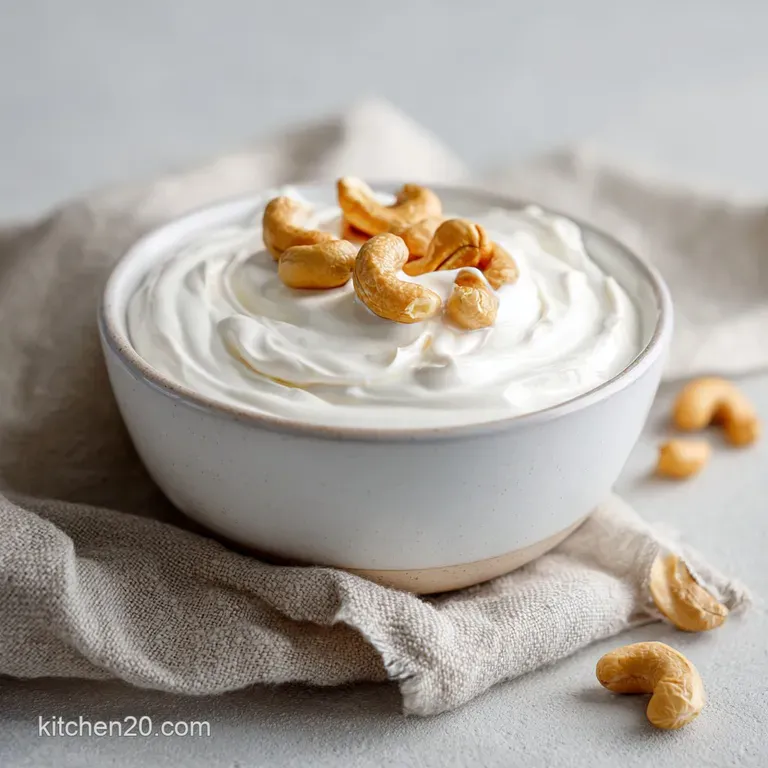
This is genuinely a simple process. The timer starts the moment the cashews hit the water.
Phase 1: Preparation (Soaking and Draining)
- Rinse the raw cashews under cold water briefly just to clean them up. Transfer them to a heatproof bowl that can handle hot liquid.
- Cover the cashews completely with genuinely hot (but not violently boiling) filtered water. Make sure they are totally submerged and let them rest for at least 2 hours. If you are using the speedy 30 minute method, use near boiling water.
- Drain the cashews thoroughly once they are soft, discarding the murky soaking water. A final rinse with cold water helps cool them down before blending.
Phase 2: High Speed Blending and Initial Mix
- Transfer those soft, pale cashews immediately to your high speed blender jug.
- Add the ½ cup of ice water, the lemon juice, the ACV, salt, and optional sugar.
- Start blending on low speed, slowly increasing to the absolute highest setting. You must blend this for a minimum of three full minutes, stopping occasionally to scrape down the sides. You are looking for zero graininess it should look like pouring paint.
- If the mixture is too stiff and the blades are spinning uselessly, add the remaining 2 Tbsp of ice water, one tablespoon at a time. The resulting consistency should be slightly thinner than finished sour cream, as it will thicken significantly upon chilling. This thinness is the secret to perfect dairy-free Sour Cream .
Phase 3: Final Flavor Adjustments and Resting
- Taste the freshly blended dairy-free Sour Cream . Does it need more tang? Add a small squeeze of lemon juice. Does it taste too flat? Add a tiny pinch more salt.
- Pour the mixture into an airtight container. This base is essentially raw cashew butter right now, but we are about to activate the setting process.
- Refrigerate for at least 1 hour. This chill time is mandatory, allowing the mixture to hydrate fully and firm up. It sets into that glorious, thick, scoopable consistency we crave.
Troubleshooting Your Cashew Sour Cream: Achieving Silky Smoothness
We all have kitchen fails, trust me. I once made a batch of cashew cream so thick it resembled plaster of Paris. If you run into issues making your dairy-free Sour Cream , here are the quick fixes.
Why Is My Cream Gritty? (The Blending Fix)
This is the most common complaint, and the fix is simple: you haven't blended long enough. Grittiness means the cashews haven't been fully broken down. Add 1 2 tablespoons of liquid (cold water or non-dairy milk) to help the mixture flow, and then blend for another 60 to 90 seconds on maximum speed.
When making dairy-free Sour Cream, patience with the blender is everything.
Adjusting Thickness: Too Thin or Too Thick?
If your final, chilled dairy-free Sour Cream is too thin, blend in 1/2 teaspoon of chia seeds (yes, really!) and let it sit for another hour. The seeds will absorb excess moisture and thicken the mixture naturally.
If it’s too thick or worse, it’s turned into cashew cream cheese simply whisk in cold water or non-dairy milk, 1 teaspoon at a time, until it reaches the desired dollop ability.
The "Waiting Game": When to Check the Final Flavor
Always do your final flavor test after the sour cream has chilled for an hour. Chilling dulls flavors slightly, but it also allows the salt and acids to fully integrate and mellow out. What tastes perfectly tart when warm might be a little too sharp when cold.
Giving your dairy-free Sour Cream time to rest is critical for a balanced finish.
Extending the Life of Your dairy-free Sour Cream
This recipe is so good, you’ll want a backup batch always ready to go. Luckily, storing this cashew based delight is straightforward.
Refrigeration Best Practices
Store your finished dairy-free Sour Cream in an airtight container (a small Mason jar works perfectly) on the main shelf of your refrigerator. It will last beautifully for 5 to 7 days. If you notice any slight separation (a thin layer of water on top), don't panic!
Just give it a quick whisk or stir, and it will snap right back to life.
Can You Freeze Cashew Based Cream?
Yes, you can freeze it, but heed this warning: dairy-free Sour Cream that is frozen and thawed will lose its ability to hold a perfect dollop. The texture changes slightly and becomes runnier because the water content separates from the cashew solids.
If you plan to use it for baking, mixing into soups, or making a ranch dressing, freezing is fine. Just scoop the sour cream into freezer safe containers, leaving a little headspace, and freeze for up to three months. To thaw, move it to the fridge overnight, then give it a vigorous whisk.
Do not expect that perfect, firm dollop when thawed it’s best used as an ingredient.
Versatility Showcase: The Best Uses for Homemade Cashew Sour Cream
This dairy-free Sour Cream is way too delicious just to be relegated to tacos (though, yes, please put it on tacos). It forms an amazing foundation for so many other recipes.
Traditional Dollops and Toppings
Nothing beats the classics. Spoon this thick, tangy goodness onto chili, vegetarian loaded nachos, or giant baked potatoes. It’s also the perfect cooling agent for anything heavily spiced, giving you a beautiful contrast. I love using this substitute when serving dishes like spicy Cream Cheese Jalapeno Poppers with Bacon: Crispy Low Carb — that cool tang cuts through the heat perfectly.
Creating Dressings and Dips
Because this cashew base is so neutral and smooth, it acts as an ideal starting point for salad dressings. Thin it out with a little extra water or non-dairy milk, add some fresh herbs, garlic, and onion powder, and you’ve made yourself a sensational ranch dressing.
It also forms the base of the most incredible French Onion Dip you’ve ever tasted. This homemade dairy-free Sour Cream is just wildly adaptable.
Sweet vs. Savory Applications
While this specific recipe targets the savory, tangy side of the equation, you can tweak the acidity for sweet applications. For a creamier, slightly sweet frosting or topping (think berry tarts or even a frosting on a classic Chocolate Cream Pie: Decadent Silky Filling Recipe ), reduce the ACV to 1 teaspoon and double the optional sugar. It keeps the richness without the heavy fermented tang. Once you master this dairy-free Sour Cream base, the possibilities are endless. Enjoy!
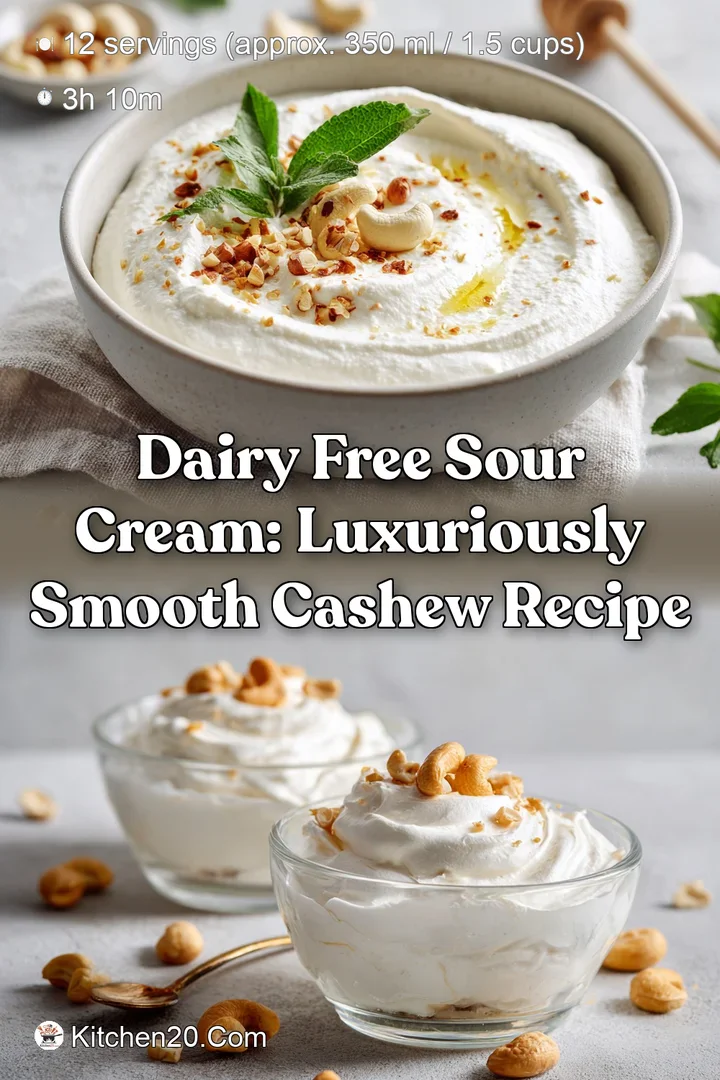
Recipe FAQs
Why is my dairy-free sour cream gritty or not perfectly smooth?
Grittiness almost always comes from inadequate preparation or blending. Ensure you soak the raw cashews in boiling hot water for at least 30 minutes (preferably 2 hours) to soften them completely before processing.
Additionally, you must use a high speed blender and run it for at least 60 seconds until the mixture heats slightly and becomes truly silky smooth; standard blenders often lack the power for this emulsion.
My sour cream isn't tangy enough. How do I adjust the flavor?
The primary tang comes from the lemon juice and/or apple cider vinegar, so if the flavor is flat, you simply need to increase the acid levels.
Start by adding half a teaspoon more of the lemon juice or vinegar, blend thoroughly, and taste again until you reach that desired classic sour cream sharpness, balancing it with a pinch more salt if necessary.
Can I use other nuts besides cashews to make this recipe?
While cashews are preferred due to their neutral flavor and high fat content which creates the creamiest texture, blanched slivered almonds can be substituted.
Note that almonds will yield a slightly nuttier flavor, and you might need additional blending time or a bit more liquid to ensure it reaches the necessary silky smoothness.
How long will this dairy-free sour cream last in the refrigerator?
When stored properly in a sealed, airtight container, homemade cashew sour cream will keep fresh in the refrigerator for 5 to 7 days.
Because it lacks the stabilizing preservatives of commercial dairy products, always perform a quick visual and sniff test before serving any remaining portion after the five day mark.
Can I freeze the cashew sour cream for later use?
It is not recommended to freeze cashew sour cream as it significantly compromises the smooth, creamy emulsion.
When thawed, the mixture often separates and develops a grainy, watery texture that is difficult, if not impossible, to re-blend back to its original luxurious consistency.
How can I make this sour cream thicker for use as a chip or vegetable dip?
To achieve a thicker, more stable dipping consistency, slightly reduce the amount of water or plant milk used initially by about 25%.
If the mixture is still too runny, refrigerate it for at least four hours; the chilling process allows the cashew fats to fully firm up, resulting in a naturally thicker product.
Is this dairy-free sour cream suitable for cooking or hot dishes?
Cashew sour cream holds up well when gently warmed, which is perfect for dolloping onto hot chili, tacos, or baked potatoes without issue.
However, avoid high heat or boiling; if the mixture is vigorously simmered or cooked for an extended period, the emulsion may break down or become oily.
Smooth dairy-free Sour Cream
Ingredients:
Instructions:
Nutrition Facts:
| Calories | 8 kcal |
|---|---|
| Protein | 0.0 g |
| Fat | 0.2 g |
| Carbs | 1.7 g |
