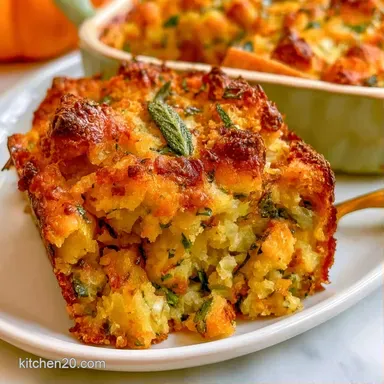
Sage Onion Stuffing with Caramelized Onions

- Prep15 Mins
- Cook55 Mins
- Servings6
A sage onion stuffing that holds together without going mushy, thanks to slowly cooked onions and a single egg. It's built for a roast, so it fits a Sunday dinner or a holiday spread.
- Time: 15 min active + 55 min cooking + 10 min resting
- Make it when: you're roasting chicken or turkey and want a side that bakes alongside it
- Pairs with: roast chicken, roast turkey, and a pan of gravy
The Liquid Decides the Texture
- Dry crumbs: Day-old bread soaks up stock slowly, so each crumb takes some liquid and none of them turn to paste.
- Deep onions: Cooked to honey-brown, the onions lose water and concentrate their sweetness. They add flavor without adding wetness.
- The egg: As the dish heats, the egg sets around the crumbs. That's what lets a slice hold its shape.
What Each Ingredient Does
Four ingredients carry most of the flavor and structure here. The egg is the one you can't swap without changing the result.
| Component | Purpose | Substitute Notes |
|---|---|---|
| Yellow onions | Sweetness and bulk | White onions work. Go by color, not the clock. |
| Large egg | Binds the crumbs and sets as it bakes | No reliable swap. Leaving it out makes the slice crumble. |
| Chicken stock with a little cider vinegar | Moisture, plus a faint sharpness that lifts the sweet onions | Vegetable stock is an approximation. See the swap table below. |
| Fresh sage | Aroma | Dried sage is stronger. Start with less and taste. |
Ingredients and Swaps
Weigh the bread if you have a scale. Six ounces (170 g) of day-old white bread gives you about 3 cups of crumbs, and fresh, soft bread packs down too dense.
- 2 tbsp unsalted butter (30 g)
- 1 tbsp olive oil (15 ml)
- 2 large yellow onions, finely chopped (about 1 lb / 450 g) Why this? Yellow onions have enough sugar to brown deeply.
- ¼ tsp fine salt (1.5 g), for the onions
- 3 cups fresh breadcrumbs (about 150 g), from about 6 oz (170 g) day-old white bread
- 2 tbsp finely chopped fresh sage (6 g)
- ½ tsp ground black pepper (1 g)
- ¼ tsp fine salt (1.5 g), for the crumbs
- 1 tsp melted butter (5 g), for greasing the dish
- 1 large egg, beaten (50 g) Why this? It binds the crumbs and sets as the dish bakes.
- ¾ cup low-sodium chicken stock
- 1 tsp cider vinegar, stirred into the stock
Most swaps change the flavor or the moisture a little, so treat the table as a starting point and taste as you go.
| Original Ingredient | Substitute | Why It Works |
|---|---|---|
| Fresh sage, 2 tbsp | Dried rubbed sage, start with 1 tsp | Dried sage is more concentrated and tastes dustier. Add a pinch more after tasting the mix. |
| Yellow onions | White onions | Sharper when raw, but they caramelize to a similar sweet brown. Cook until the color matches. |
| Low-sodium chicken stock | Low-sodium vegetable stock | Same liquid volume, so it still moistens the crumbs. Tastes sweeter and less savory. |
| Day-old white bread | Day-old sourdough or country loaf | Chewier crumb that absorbs more liquid. Add stock 1 tbsp at a time. |
| Unsalted butter | Salted butter | Same fat. Cut the salt in the crumbs back to a pinch. |
Timing and Yield
Plan for 15 minutes of prep, 10 minutes of cooling for the onions, and 55 minutes of cooking. That brings the total to 1 hour 20 mins from start to table. The recipe serves 6 as a side.
Key Steps
Step 1: Melt the Butter
Melt the 2 tbsp butter with the olive oil in a large heavy skillet over medium heat. Wait until the butter foams and stops sizzling, which means the water has cooked off.
Step 2: Soften the Onions
Add the onions and ¼ tsp salt. Cook about 8 minutes, stirring now and then, until soft and translucent, like wilted spinach. The salt pulls moisture out of the onions, which speeds up the softening.
Step 3: Lower the Heat
Turn the heat to medium-low and cook 15 to 17 minutes more, stirring every 3 minutes, until deep honey-brown and sticky. If brown bits cling to the pan, add 1 tbsp water and scrape them up. Those bits carry a lot of the flavor.

Step 4: Cool the Onions
Move the onions to a plate and let them cool about 10 minutes, until no longer steaming. A plate cools them faster than leaving them piled in the pan.
Step 5: Prep the Dish
Preheat the oven to 375°F (190°C). Brush an 8-inch (20 cm) square baking dish with the 1 tsp melted butter.
Step 6: Mix the Crumbs
In a large bowl, combine the breadcrumbs, sage, black pepper, and ¼ tsp salt. Mixing the dry ingredients first spreads the sage evenly.
Step 7: Fold in the Onions
Stir in the cooled onions and any butter left in the pan. Scrape the pan well, since that butter is flavorful.
Step 8: Add Egg and Stock
Whisk the beaten egg with the chicken stock and cider vinegar. Pour it over the crumbs and stir with a fork until every crumb looks evenly damp. Do not overmix, or the crumbs break down.

Step 9: Press Into the Dish
Press the mixture firmly into the greased dish.
Chef's Note: Press the corners and edges first, then the middle. A loose heap dries out at the edges while the center stays soft.
Step 10: Bake Until Golden
Bake 30 to 35 minutes until the top is deep golden and the edges pull slightly from the sides. Check the center with an instant-read thermometer. It should reach 165°F (74°C).

If Something Goes Wrong
Fixing a Gluey, Wet Center
Too much stock or very soft bread leaves the crumbs waterlogged. Stop adding liquid once the crumbs look evenly damp. If the mix still looks wet, stir in a few more crumbs.
When the Mix Is Too Dry
Stale bread or a light hand with the stock leaves the crumbs crumbly and hard to press. Add stock 1 tbsp at a time until the mix holds together when you squeeze a handful.
When the Top Browns Too Fast
A dish set high in the oven or a very hot oven can color the top before the center sets. Move the rack to the middle of the oven. Lay a loose sheet of foil over the top for the last 10 minutes.
Stopping Onions From Burning
Bits stuck to the pan and a high flame cause most burnt onions. Keep the heat at medium-low once the onions have softened. Add a tablespoon of water when the bits start to catch, then scrape.
| Problem | Root Cause | Solution |
|---|---|---|
| Gluey, wet center | Too much stock, or very soft fresh bread | Stop adding stock once crumbs look damp. Stir in a few more crumbs if it's wet. |
| Dry, crumbly mix | Stale bread, or too little stock | Add stock 1 tbsp at a time until the mix holds when squeezed. |
| Top browns too fast | Dish too high in the oven | Move the rack to the middle. Cover loosely with foil for the last 10 minutes. |
| Onions burn in the pan | Heat too high, or dry bits sticking | Drop to medium-low. Add 1 tbsp water and scrape the pan. |
Storing and Reheating Leftovers

Cover any leftovers and refrigerate them within 2 hours of baking. They will keep for 3 to 4 days, although they are best on the day they are made.
To reheat, cover the dish with foil and bake for 15 minutes at 350°F (175°C). If the dish seems dry, add a splash of stock, then uncover it for the final 3 minutes to re-crisp the top. Continue heating until the center reaches 165°F (74°C).
Presentation Tips
Serve it straight from the dish at the table, since the crisp edges look best that way. Cut squares with a sharp knife, and lift them out with a spatula so the crust stays intact. It sits well next to roast chicken or turkey, with gravy spooned over.
Make It Your Own
To achieve a more intense sweetness, let the onions cook for a few extra minutes during Step 3 until they are a deeper brown. Rely on the color rather than the timer, as onions vary in size and moisture.
If you prefer a cornbread base with pecans, check out this cornbread dressing recipe for a distinct flavor and texture.
Common Questions
How much sage should I add to my stuffing?
Use 2 tbsp of finely chopped fresh sage. That amount gives a clear savory flavor without overpowering the onions and bread. Chop it fine so the leaves distribute evenly through the breadcrumbs.
Is stuffing ok for weight loss?
It can fit a weight-loss plan if you watch portions. This recipe makes 6 servings at about 174 calories each, so one measured serving is a reasonable side dish. Going back for seconds is what adds up fast.
What are common stuffing mistakes to avoid?
Don't overmix once the egg and stock go in. Stir with a fork only until every crumb looks evenly damp, or the stuffing turns dense and gummy. Also let the onions cool for about 10 minutes before combining, since hot onions can make the bread soggy and uneven.
What if the stuffing browns too quickly in the oven?
Loosely cover the dish with foil and keep baking at 375°F (190°C). Bake until the top is deep golden and the center reaches 165°F (74°C) on a thermometer. Lift the foil for the final stretch to let the surface crisp again.
Sage Onion Stuffing with Caramelized Onions
Ingredients:
Instructions:
Keep Cooking

Grandmas Thanksgiving Stuffing: Classic Sage Sausage Dressing
Grandmas Thanksgiving Stuffing is cornerstone of any feast. Get grandmas thanksgiving stuffing…

Southern Thanksgiving Menu: Classic Sage Pecan Cornbread Dressing Recipe
Nail your Southern Thanksgiving Menu with this legendary cornbread dressing.

Homemade Stuffing: The Traditional Recipe for a Crisp, Moist Center.
Homemade Stuffing guarantees a crisp, golden top and deeply savory, moist interior.
